
North Carolina Drivers Ed Practice Test 8

5 out of 5 (34 votes)
80% Passing score
20 Questions
4 Mistakes allowed
Intersections are where driving in North Carolina gets a little too honest. Everyone shows up at once, somebody waves when they should not, another person creeps forward like that somehow counts as communication, and suddenly the simple idea of “who goes first” feels weirdly dramatic. So, yes, this NC DMV practice test spends time on intersection rules, because that is where a lot of new drivers quietly realize the road is not always as tidy as the handbook makes it sound. This NC practice permit test gives you 20 multiple-choice questions built around the stuff that actually matters at intersections: right-of-way, four-way stops, traffic signals, turns, signs, and those small judgment calls that do not look exciting until you are the one sitting behind the wheel. The questions are meant to feel practical, not like they were scraped from the back of a dusty government pamphlet and then lightly threatened into being educational. You get practice with the rules, sure, but also with the little driving instincts that keep you from freezing up when three cars arrive at nearly the same time and everyone suddenly becomes a philosopher. For the real North Carolina permit test, here is the DMV-shaped part of the story. The written knowledge test has 25 multiple-choice questions about traffic laws and safe driving, and you need 20 correct answers to pass. That is 80%, which sounds friendly until you remember that missing a few easy ones because you skimmed is still, annoyingly, a thing. There is no time limit, so you can breathe. You will also take a road signs test, where you identify signs by color and shape and explain what they mean. Miss more than three there, and the DMV will not be charmed by your confidence. Adult applicants also need to pass a vision test. The actual test has to be taken in person at an NCDMV office. No online shortcut, unfortunately. Bring proof of identity and date of birth, proof of Social Security number, proof of North Carolina residency, and the permit or license fee. Under 18? Add a Driving Eligibility Certificate, a Driver’s Education Certificate, and a parent or guardian to the little paperwork parade. This North Carolina drivers ed practice test is updated for 2026 and works on mobile, desktop, and app, so you can study in whatever oddly specific corner of your day you can steal.
FREE DMV Practice Test App
Study for your North Carolina permit test or driver’s license with the NextDoorDriving app. 700+ DMV questions and answers, 100% free!
Download on the App Store

Sample North Carolina Permit Test Questions

Question 1

Which condition is required when towing a trailer on a highway?

  1. A. The towing vehicle may never exceed 45 mph
  2. B. The trailer must be attached and equipped to follow without snaking
  3. C. The driver must obtain special state permission for every trailer
  4. D. All of the above

Correct answer: B. – The trailer must be attached and equipped to follow without snaking

North Carolina law requires a trailer or other towed vehicle to be firmly attached and equipped so that it does not snake but follows the towing vehicle’s path. When the primary attachment is a ball hitch, safety chains or cables strong enough to hold the trailer’s gross weight are generally required if the primary connection fails.

Source: G.S. 20-123(b), (c) – Trailers and Towed Vehicles
Question 2

When approaching a railroad crossing without lights or gates, you should:

  1. A. Always stop even when no stop sign or train is present
  2. B. Slow down, look and listen, and be prepared to stop
  3. C. Continue normally because every crossing has active signals
  4. D. Accelerate to spend less time near the tracks

Correct answer: B. – Slow down, look and listen, and be prepared to stop

Approach every railroad crossing cautiously, including one without lights or gates. Slow down, look in both directions, listen, and prepare to stop for a train. Cross only when the tracks are clear and there is enough space beyond them for your entire vehicle; never stop on the tracks.

Source: North Carolina Driver Handbook — Ch. 4, “Railroad Crossing Safety”

Question 3

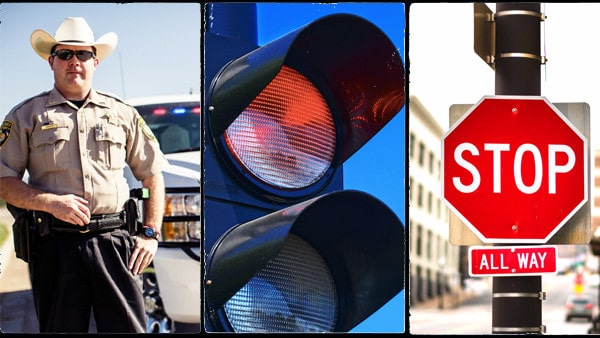
Which instruction takes priority when it conflicts with the listed traffic controls?

Which of the following must you obey over the other three?
  1. A. A steady red traffic signal
  2. B. A lawful direction from an authorized officer controlling traffic
  3. C. A stop sign
  4. D. A flashing red signal

Correct answer: B. – A lawful direction from an authorized officer controlling traffic

A driver must comply with a lawful traffic direction given by an authorized law-enforcement or traffic-control officer. The North Carolina handbook instructs drivers to obey an officer’s hand signals instead of the normal signs or traffic signals when the officer is directing traffic. Watch the officer carefully and follow the indicated movement.

Source: G.S. 20-114.1(a) – Willful Failure to Obey Law-Enforcement or Traffic-Control Officer; Firemen as Traffic-Control Officers; Appointment, Etc., of Traffic-Control Officers, North Carolina Driver Handbook — Ch. 5, “Traffic Officers”

Question 4

When another vehicle may be affected, drivers must signal before:

  1. A. Turning or changing lanes
  2. B. Entering or leaving a freeway lane
  3. C. Starting from a parked or roadside position
  4. D. Any of these movements

Correct answer: D. – Any of these movements

North Carolina requires a signal when another vehicle may be affected by a driver’s starting, stopping, turning, or movement from a direct line. Turn signals must be maintained continuously for the last 100 feet before a turn. Where the speed limit is at least 45 mph, a signal for turning from a direct line must be given for the last 200 feet.

Source: G.S. 20-154(a), (b) – Signals on Starting, Stopping or Turning

Question 5

Before merging from an interstate entrance ramp, how should you check the lane you intend to enter?

When you enter a freeway, you should check traffic by using:
  1. A. Use the inside and outside mirrors only
  2. B. Check only the rearview mirror
  3. C. Check the side and rearview mirrors, then look over your shoulder
  4. D. Check only the left side-view mirror

Correct answer: C. – Check the side and rearview mirrors, then look over your shoulder

When entering a North Carolina interstate, use the acceleration lane to match traffic speed before merging safely. Check the side and rearview mirrors, but remember that mirrors do not show every area beside your vehicle. Look over your shoulder to verify that the blind spot is clear, signal, and merge only when the movement can be completed safely.

Source: North Carolina Driver Handbook — Ch. 4, “Changing Lanes”; Ch. 4, “Interstate Highways”

Question 6

Four-way emergency flashers on a moving passenger vehicle primarily warn other drivers of:

If you see warning hazard lights on a moving passenger vehicle, it means:
  1. A. A required turn in the opposite direction
  2. B. A mandatory stop on the shoulder
  3. C. A possible danger or unusual condition
  4. D. A special right-of-way privilege

Correct answer: C. – A possible danger or unusual condition

Emergency warning flashers activate all four turn-signal lights at once. The driver handbook identifies them as a warning of possible danger or of a vehicle that is stopped or disabled. When the vehicle is moving, the flashers should be understood as a general danger warning rather than an ordinary turn signal.

Source: North Carolina Driver Handbook — Ch. 4, “Emergency Warning Flashers”