

Tennessee Drivers Ed Practice Test 8

5 out of 5 (30 votes)
80% Passing score
20 Questions
4 Mistakes allowed
This TN practice permit test is built around the kind of driving knowledge that sounds simple when someone explains it out loud, then gets a little less simple when four cars are sitting at an intersection and everyone seems to think they arrived first. As the eighth DMV practice test in the series, it spends extra time on right-of-way rules, four-way stops, and intersection decisions — the small, ordinary moments where new drivers either show they understand the road or, well, start guessing. The real Tennessee knowledge test includes 30 questions, and passing means scoring at least 80%. In plain terms, that is 24 correct answers, with no more than 6 missed. The online test allows 60 minutes, 2 attempts, and a 24-hour wait before another online retake if both attempts are used. It is available in English and Spanish. This Tennessee drivers ed practice test is shorter, with 20 multiple-choice questions, but it is aimed at the same basic skill: reading the situation carefully enough to choose the safest, legal answer. There are study aids built in, and they are actually worth using. A hint can nudge you when two answers feel close, which happens more often than people like to admit. If you miss a question, the explanation gives you the reasoning behind the correct answer, not just a quick correction. Also, this practice drivers ed permit test is not timed. That matters. Intersection questions often need a second pass, maybe even a third, because the order of arrival, signs, signals, and turning movements all matter at once — a little cluttered, but that is driving. For Tennessee teens, the learner permit starts at age 15. A licensed driver who is at least 21 must ride in the front seat, and permit driving is restricted from 10 p.m. to 6 a.m. Before moving to an Intermediate Restricted License at 16, a teen driver must hold the permit for 180 days and complete 50 supervised driving hours, including 10 at night. So yes, this TN permit practice test helps with the written exam, but it also does something more practical. It starts training the judgment Tennessee expects before a new driver is handling traffic in Nashville, Memphis, Chattanooga, the Smokies, or the intersection two minutes from home.
FREE DMV Practice Test App
Study for your Tennessee permit test or driver’s license with the NextDoorDriving app. 700+ DMV questions and answers, 100% free!
Download on the App Store

Sample Tennessee Permit Test Questions

Question 1

Before beginning a pass, where should a driver be especially alert for people or vehicles entering the roadway?

  1. A. At intersections and junctions
  2. B. Near railroad crossings
  3. C. At busy business entrances and exits
  4. D. At all of these locations

Correct answer: D. – At all of these locations

Intersections, railroad crossings, and driveways all require careful observation before a passing maneuver. Passing on the left is restricted near intersections and railroad crossings because sight distance and crossing traffic may create hazards. The driver should also scan entrances and exits for vehicles or people who may move into the roadway.

Source: Tenn. Code Ann. § 55-8-121 — Further limitations on driving on left of center of roadway, Tennessee Comprehensive Driver License Manual — Section C, Ch. 1, “Scanning the Road and Traffic for Defensive Reactions”

Question 2

Which check must you make before moving into an adjacent lane?

  1. A. Confirm that no vehicle is anywhere behind you
  2. B. Check your mirrors and look over your shoulder for the blind spot
  3. C. Look only in the direction the vehicle is moving
  4. D. Rely only on the outside mirrors

Correct answer: B. – Check your mirrors and look over your shoulder for the blind spot

Check the rearview and outside mirrors, then briefly look over the appropriate shoulder to inspect the blind spot. Signal when other traffic may be affected and verify that the movement can be made safely. In Tennessee, the driver remains responsible for ensuring the adjacent lane is clear before changing lanes.

Source: Tenn. Code Ann. § 55-8-142 — Turning movements, Tenn. Code Ann. § 55-8-143 — Signals for turns, Tennessee Comprehensive Driver License Manual — Section B, “Passing”

Question 3

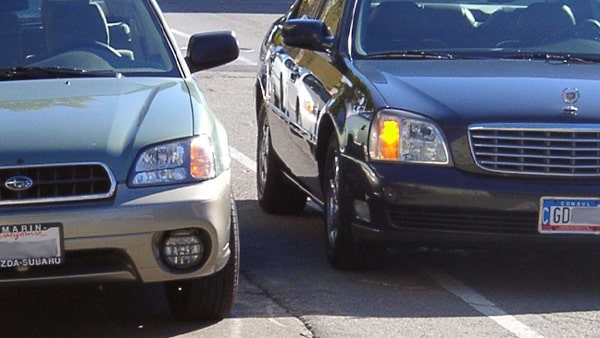
Which statement correctly describes parking alongside a vehicle already parked at the curb?

Which of the following is true about double parking?
  1. A. It is prohibited as an ordinary parking practice
  2. B. It is permitted if you remain behind the wheel
  3. C. It is permitted while making a delivery
  4. D. It is permitted if the parked vehicle can still leave

Correct answer: A. – It is prohibited as an ordinary parking practice

Tennessee prohibits stopping, standing, or parking on the roadway side of a vehicle stopped or parked at the edge or curb. Remaining in the vehicle or making a delivery does not create a general exception. The law does recognize limited situations involving traffic conflicts or compliance with a law, police officer, or traffic-control device.

Source: Tenn. Code Ann. § 55-8-160(a)(1), (b) — Stopping, standing or parking prohibited in specified places, Tennessee Comprehensive Driver License Manual — Section B, “No Parking Zones”

Question 4

How should you respond to a flashing yellow traffic signal at an intersection?

  1. A. Continue at the same speed while watching other traffic
  2. B. Make a complete stop before entering
  3. C. Slow down and proceed cautiously
  4. D. Wait for the signal to display green

Correct answer: C. – Slow down and proceed cautiously

A flashing yellow signal permits a driver to proceed through the intersection with caution. The Tennessee manual instructs drivers to slow down and carefully check the intersection. Be prepared to yield or stop when necessary for pedestrians, vehicles, or other hazards already in your path.

Source: Tenn. Code Ann. § 55-8-110(e)(2) — Traffic-control signal legend, Tennessee Comprehensive Driver License Manual — Section B, “Traffic Signals”

Question 5

What could happen if you turn the ignition to the lock position while driving a vehicle with a steering-wheel interlock?

  1. A. The steering may lock, causing you to lose control
  2. B. The steering will continue operating normally
  3. C. The vehicle will safely coast downhill
  4. D. Only the power brakes will be affected

Correct answer: A. – The steering may lock, causing you to lose control

Never turn the ignition to the lock position while the vehicle is moving. In a vehicle equipped with a steering-wheel interlock, the steering can lock when you attempt to turn. Losing the ability to steer can result in immediate loss of vehicle control.

Source: Tennessee Comprehensive Driver License Manual — Section B, “Special Warning: For Drivers with Steering Wheel Interlock System”

Question 6

When changing lanes on an interstate, which procedure is correct?

When changing lanes on a freeway, you should:
  1. A. Signal before moving and verify that the adjacent lane is clear
  2. B. Cross several lanes in one continuous movement
  3. C. Drive along the broken lane line until traffic makes room
  4. D. Use the horn instead of a turn signal

Correct answer: A. – Signal before moving and verify that the adjacent lane is clear

Tennessee does not use the original question’s fixed five-second freeway rule. Instead, signal before the lane change when other traffic may be affected, check the mirrors and blind spot, and move only after determining that it is safe. Change one lane at a time and cancel the signal after completing the movement.

Source: Tenn. Code Ann. § 55-8-142 — Turning movements, Tenn. Code Ann. § 55-8-143 — Signals for turns, Tennessee Comprehensive Driver License Manual — Section B, “Passing”