
Tennessee DMV Test Evaluation

5 out of 5 (30 votes)
80% Passing score
10 Questions
2 Mistakes allowed
A Tennessee practice permit test should give you a pretty honest read on whether the Driver’s Manual is actually sticking, not just whether a few familiar road-sign shapes feel vaguely familiar. This version keeps it tight with 10 questions, and you’ll need 8 correct answers to pass, which mirrors Tennessee’s 80% passing standard without making you sit through the full official test every time you want to check your progress. The real Tennessee Class D knowledge test is bigger, of course: 30 multiple-choice questions, 24 correct answers required, and for eligible 15- to 17-year-olds taking it online, a 60-minute limit. That online option comes with its own little bundle of rules — parent or legal guardian supervision through the Tennessee Proctor ID App, English or Spanish testing, no drifting off the test screen, and a 24-hour wait if you fail. So, yes, practicing beforehand is not just “nice.” It is the sensible move. The questions here stay in the same lane as the official material: Tennessee traffic laws, safe driving practices, road signs and signals, right-of-way rules, pavement markings, alcohol and drug rules, and the general driver-responsibility material that tends to show up when people were hoping for something easier. There is no timer on this practice test, which is good. Rushing through permit questions teaches you almost nothing, except maybe that you can click quickly while being half-sure. Better to slow down, notice the wording, and catch the weak spots before they cost you on the real exam. Once you finish, you’ll get a summary showing what you missed and what the correct answers were. That part matters. A score by itself is only mildly useful; the review is where you see whether you need more work on signs, GDL rules, nighttime restrictions, supervised driving requirements, or the everyday driving-law details that blur together after a while. For teens, the permit test is just the first gate in Tennessee’s graduated driver license process, starting at age 15 and eventually moving through supervised practice, 50 required driving hours, 10 of them at night, and the road skills test. Adults skip the teen GDL structure, but they still have to deal with documents, vision screening, the knowledge test, and usually a learner permit before the road test. This Tennessee learners permit practice test is a small step, but an important one.
FREE DMV Practice Test App
Study for your Tennessee permit test or driver’s license with the NextDoorDriving app. 700+ DMV questions and answers, 100% free!
Download on the App Store

Sample Tennessee Permit Test Questions

Question 1

Driving substantially slower than normal traffic without a safety-related reason may:

  1. A. Impede the normal movement of traffic
  2. B. Always make the roadway safer
  3. C. Remove the need to watch surrounding traffic
  4. D. Allow you to ignore a posted minimum speed

Correct answer: A. – Impede the normal movement of traffic

In Tennessee, a driver may not travel so slowly that the vehicle impedes the normal and reasonable movement of traffic. This rule does not apply when reduced speed is necessary for safe operation or compliance with the law. Drivers must adjust speed for traffic, visibility, weather, and roadway conditions rather than automatically matching faster traffic.

Source: Tenn. Code Ann. § 55-8-154(a) — Minimum speed regulations, Tennessee Comprehensive Driver License Manual — Section B, “Speed and Speed Limits”
Question 2

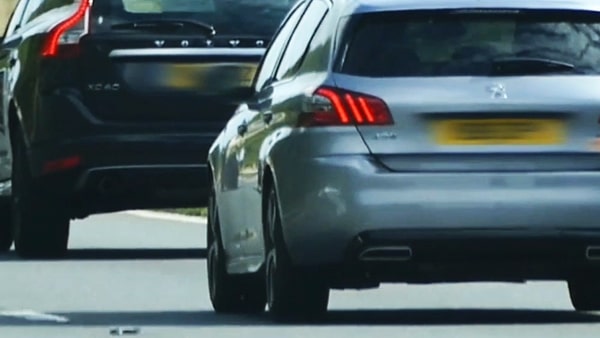
When should you signal your intention to move left and pass another vehicle?

  1. A. Only as the vehicle begins crossing the centerline
  2. B. At any time during the maneuver
  3. C. After entering the passing lane
  4. D. Before moving, early enough to communicate your intended lane change

Correct answer: D. – Before moving, early enough to communicate your intended lane change

Signal before moving into the passing lane when the maneuver may affect other traffic. The signal communicates your intended movement, but it does not establish that the lane is clear. Check the mirrors and blind spot, pass only when safe and legal, and signal again before returning to the original lane.

Source: Tenn. Code Ann. § 55-8-143 — Signals for turns, Tennessee Comprehensive Driver License Manual — Section B, “Passing”

Question 3

Another vehicle moves into the space directly ahead of you. What is usually the best first response?

If another driver "cuts" in front of you, it would be better if you:
  1. A. Ease off the accelerator to rebuild your following space
  2. B. Apply the brakes as hard as possible
  3. C. Accelerate to keep the other vehicle from entering
  4. D. Sound the horn continuously

Correct answer: A. – Ease off the accelerator to rebuild your following space

Ease off the accelerator to increase the distance between your vehicle and the one that moved ahead of you. A safe space cushion gives you more time to observe and respond to changing traffic. If additional slowing is needed, brake gradually unless an immediate emergency requires stronger action.

Source: Tennessee Comprehensive Driver License Manual — Section B, “Following Distances”, Tennessee Comprehensive Driver License Manual — Section B, “Braking”

Question 4

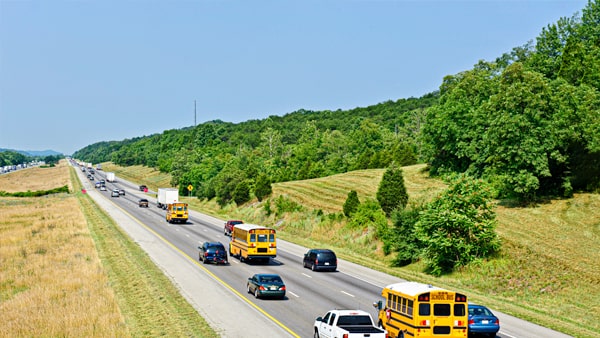
In Tennessee, a school bus stops with its red signals operating on the opposite side of a four-lane road separated only by a four-foot paved strip. What must you do?

If a school bus stops to unload children on a four-lane highway, divided by a four-foot paved strip, vehicles traveling in the opposite direction are:
  1. A. Stop and remain stopped until the bus proceeds or its signals are no longer operating
  2. B. Stop briefly, then pass at low speed
  3. C. Move onto the shoulder and continue
  4. D. Continue because four lanes always make stopping unnecessary

Correct answer: A. – Stop and remain stopped until the bus proceeds or its signals are no longer operating

Drivers approaching a stopped school bus from either direction must stop when its required visual signals are operating. The exception for opposing traffic applies when the bus is on a different roadway of a divided highway. The official manual explains that a painted or narrow paved center area does not qualify like a raised barrier or an unpaved median at least five feet wide.

Source: Tenn. Code Ann. § 55-8-151(a) — Overtaking and passing school, youth or church bus — Markings — Discharging passengers — Penalties, Tennessee Comprehensive Driver License Manual — Section C, Ch. 3, “Sharing the Road with School Buses”

Question 5

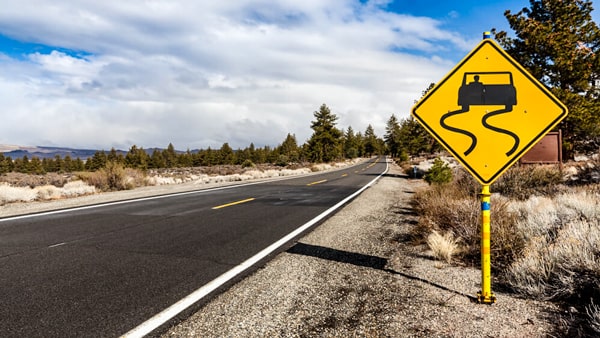
How should you operate your vehicle when the roadway is slippery?

When roads are slippery, you should:
  1. A. Look a shorter distance ahead
  2. B. Stop on hills to test tire traction
  3. C. Avoid abrupt turns and sudden stops
  4. D. Continue at the normal dry-road speed

Correct answer: C. – Avoid abrupt turns and sudden stops

Slippery pavement reduces the traction available for accelerating, turning, and stopping. Reduce speed and make steering, braking, and acceleration inputs smoothly. Avoid fast turns or sudden stops because either action may cause the tires to lose their grip and the vehicle to skid.

Source: Tennessee Comprehensive Driver License Manual — Section C, Ch. 2, “Understanding Road and Traffic Conditions”

Question 6

If your vehicle is equipped with airbags, when should you wear the safety belt?

  1. A. Only while driving on an interstate
  2. B. Whenever the vehicle is moving forward
  3. C. Only outside city limits
  4. D. Only at speeds above 35 mph

Correct answer: B. – Whenever the vehicle is moving forward

Tennessee requires the driver and covered front-seat occupants to be properly restrained while a passenger vehicle is in forward motion. Airbags provide supplemental protection and do not replace lap-and-shoulder belts. Wear the belt correctly across the hips and shoulder rather than placing the shoulder portion behind your back or under your arm.

Source: Tenn. Code Ann. § 55-9-603(a) — Use of safety belt in passenger vehicles — Violations — Penalties, Tennessee Comprehensive Driver License Manual — “Protecting Passengers/Drivers”