

Tennessee Road Signs Test Simulator

5 out of 5 (30 votes)
80% Passing score
25 Questions
5 Mistakes allowed
This practice test is for adults trying to squeeze in one more study session before visiting Driver Services, for teens starting the learner permit process at 15, new residents sorting out what carries over and what does not, and anyone who knows road signs well enough in everyday traffic but maybe not well enough when the answer choices start looking a little too similar. This Tennessee DMV road signs practice test focuses on the signs-and-signals material that appears on the Regular Class D knowledge test. Tennessee does not treat road signs as a separate official test for standard Class D applicants, but they are absolutely part of the real exam, along with traffic laws, pavement markings, safe driving practices, alcohol and drug rules, and driver responsibility. The official knowledge test has 30 multiple-choice questions, and the passing score is 80%, which means 24 correct answers. That number is worth keeping in your head, because it gives your studying some shape instead of turning it into vague “I’ll review the manual later” energy. Here, each practice session gives you 20 road sign questions pulled from a larger bank, so the test does not feel like the same little loop every time. You need 16 correct answers to pass this simulator, which keeps the same 80% benchmark as Tennessee’s actual knowledge test while making the session shorter and easier to repeat. And repeating it matters. Not in a robotic memorize-the-letter-choice way, but in the more useful way where sign shapes, colors, warnings, lane markings, and traffic signals start becoming familiar before you are under test pressure. After you finish, the review shows what you missed and gives the correct answers, which is where the real studying usually happens. A missed sign question is not a disaster; it is just a small flare showing you where the manual, a road sign chart, flashcards, or a quick extra round of practice would be worth your time. Use this alongside the Tennessee driver manual and other permit test prep, and it becomes a focused, practical way to tighten up one of the most visual parts of the TN DMV permit test.
FREE DMV Practice Test App
Study for your Tennessee permit test or driver’s license with the NextDoorDriving app. 700+ DMV questions and answers, 100% free!
Download on the App Store

Sample Tennessee Permit Test Questions

Question 1

At a Tennessee intersection, what must you do when the traffic signal flashes red?
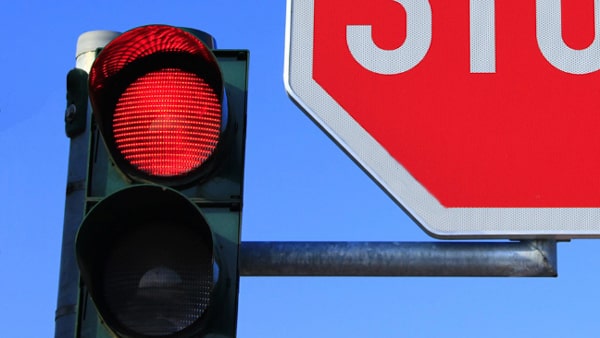
If you are approaching an intersection with a red flashing light, what should you do?
  1. A. Continue through without reducing speed
  2. B. Slow down and yield without stopping
  3. C. Remain stopped until the signal turns green
  4. D. Come to a complete stop, then proceed when it is safe

Correct answer: D. – Come to a complete stop, then proceed when it is safe

A flashing red signal requires a complete stop before entering the intersection. After stopping, yield according to the rules that apply at a stop sign. Proceed only when the intersection is clear and the movement can be made safely.

Source: Tenn. Code Ann. § 55-8-112 — Flashing Signals, Tennessee Comprehensive Driver License Manual — Section B, “Stopping at Intersections”

Question 2

What does a yellow arrow for a dedicated left-turn lane tell you?

  1. A. Accelerate before opposing traffic is released
  2. B. The turn is prohibited until a green circular light appears
  3. C. The protected turn is ending, so be ready to follow the next signal
  4. D. Continue turning because you still have an unconditional right-of-way

Correct answer: C. – The protected turn is ending, so be ready to follow the next signal

A yellow arrow warns that the movement previously allowed by the green arrow is ending. The signal will change to another indication, such as a red arrow or a different green signal. Watch for and obey that next indication rather than accelerating to enter the intersection.

Source: Tenn. Code Ann. § 55-8-110(a)(5) — Traffic-Control Signals — Inoperative Signals, Tennessee Comprehensive Driver License Manual — Section B, “Traffic-Control Signals”

Question 3

What is the purpose of a yellow-and-black diamond-shaped road sign?

A yellow and black diamond-shaped sign:
  1. A. To warn of a condition or hazard on or near the roadway
  2. B. To provide directions to nearby communities
  3. C. To state a traffic law that drivers must obey
  4. D. To identify only road construction areas

Correct answer: A. – To warn of a condition or hazard on or near the roadway

In Tennessee, yellow-and-black diamond signs warn drivers about roadway conditions, intersections, changes in alignment, or other hazards ahead. Regulatory signs use different shapes and colors to communicate legal requirements. Orange-and-black signs generally provide warnings in temporary traffic-control and work zones.

Source: Tennessee Comprehensive Driver License Manual — Section B, “Warning Signs”

Question 4

Before following a green arrow, which condition must you verify?

  1. A. The driver behind you has started moving
  2. B. The arrow has been displayed for at least five seconds
  3. C. Vehicles, bicyclists, and pedestrians lawfully in your path have cleared
  4. D. Only motor vehicles, not pedestrians, have cleared your path

Correct answer: C. – Vehicles, bicyclists, and pedestrians lawfully in your path have cleared

A green arrow permits movement in the arrow’s direction, but the driver must still yield to other traffic lawfully using the intersection and to pedestrians in an adjacent crosswalk. In Tennessee, a bicycle is subject to the applicable vehicle rules when operated on a roadway. Begin the turn only after the path is clear.

Source: Tenn. Code Ann. § 55-8-110(a)(4) — Traffic-Control Signals — Inoperative Signals, Tennessee Comprehensive Driver License Manual — Section B, “Traffic-Control Signals”

Question 5

Your signal turns green while other traffic is still clearing the intersection. What should you do?

  1. A. Enter and wait inside the intersection
  2. B. Drive around the clearing vehicles
  3. C. Remain stopped until the intersection is clear
  4. D. Enter immediately because the green light gives you priority

Correct answer: C. – Remain stopped until the intersection is clear

Traffic facing a green signal may proceed, but it must yield to vehicles and pedestrians lawfully within the intersection or an adjacent crosswalk. Wait until the remaining traffic has cleared your path. Enter only when you can proceed safely.

Source: Tenn. Code Ann. § 55-8-110(a)(1)(A) — Traffic-Control Signals — Inoperative Signals

Question 6

On a two-way Tennessee road, what do two solid yellow center lines indicate?

  1. A. Passing is allowed whenever no traffic is approaching
  2. B. Passing is prohibited for traffic in both directions
  3. C. The space between the lines is a center left-turn lane
  4. D. The lines separate lanes traveling in the same direction

Correct answer: B. – Passing is prohibited for traffic in both directions

Two solid yellow lines separate opposing traffic and prohibit passing from either direction. A broken yellow line permits passing from the side next to the broken line when the way is clear and the maneuver is safe. Double solid lines do not mark a center turn lane.

Source: Tennessee Comprehensive Driver License Manual — Section B, “General Principles of Pavement Lane Markings”